5 Warning Signs Your GLP-1 Constipation Is Actually a Stomach Problem — Not a Colon Problem
5 Warning Signs Your GLP-1 Constipation Is Actually a Stomach Problem — Not a Colon ProblemGLP-1 Health Review
Health & Wellness
Medical Review Board
5 Warning Signs Your GLP-1 Constipation Is Actually a Stomach Problem — Not a Colon Problem
If laxatives, fiber, and magnesium aren't working, you may be treating the wrong organ entirely.
Dr. Rebecca MarshGastroenterologist · 18 Years in Practice
⏱ 6 min read
Millions of GLP-1 users are spending hundreds of dollars monthly on products aimed at the wrong organ.
In 18 years of practice, I've seen the same pattern hundreds of times.
A woman in her 50s or 60s walks into my office. She's lost 30 pounds on Ozempic® or Mounjaro® and she's terrified to keep taking it. Not because of the shot itself — because of what it's doing to her digestion.
She hasn't had a normal bowel movement in two weeks, her stomach feels heavy within three bites of any meal, and she's burping a smell that makes her brush her teeth four times a day and turn her face away from her husband at night.
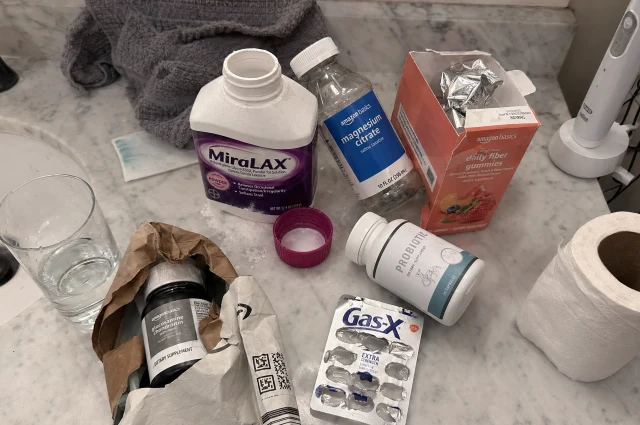
She opens her purse and shows me what she's been doing — Miralax in the morning, magnesium at bedtime, fiber gummies after lunch, Gas-X for emergencies, stool softeners on bad days, Smooth Move tea when nothing else works. Sometimes $400 worth of products in a single month.
And nothing is working consistently.
She's been told to drink more water by her primary care doctor. Her gynecologist suggested adding fiber. A telehealth nurse said it was probably stress.
None of them mentioned what I'm about to tell you.
Her constipation has nothing to do with her colon. It's an upstream problem. And every product she's been taking is aimed six feet downstream from where the actual problem starts.
If you're recognizing yourself in any of that, I want to walk you through the 5 most common signs your GLP-1 digestive side effects are an upstream stomach motility problem — not the colon issue you've been treating.
Sign #1
Food Sits For Hours After Tiny Meals
You eat half a sandwich and feel like you swallowed a brick.
A few bites of dinner leave you uncomfortably full for the rest of the night. You go to bed still tasting the meal you ate six hours earlier. Some mornings, you wake up feeling like dinner never moved at all.
Here's the mechanism behind that.
Every GLP-1 medication slows something called gastric emptying — the rate at which food leaves your stomach and enters your intestines. That slowdown is part of how the medication works. It's why you feel full faster, why you eat less, and why the scale finally moved.
But for a lot of women, the stomach slows too much.
Food that should leave your stomach in two hours sits for five, six, seven hours. By the time it does empty, the next meal is already on top of it. The whole digestive train backs up — and the backup begins at the very first stop.
This is why colon-focused remedies feel so hit-or-miss. They're working downstream from where the traffic actually starts.
Sign #2
Fiber Made You More Bloated, Not Less
Every doctor said the same thing: "Add more fiber."
So you did. Fiber gummies. Psyllium powder. Fiber cereal. Fiber bars. And within a few days, your stomach got worse.
Heavier. Tighter. The bloat got more visible, not less. You started avoiding mirrors and elastic waistbands.
There's a specific reason this happens for GLP-1 users — and it's not true for the general population.
Fiber works by adding bulk that stimulates intestinal movement. That's helpful when your digestive system is functioning at normal speed. But when your stomach is already slowed by a GLP-1 medication, adding bulk on top of a system that isn't moving is like dumping more cars into a freeway pile-up.
You're not adding flow. You're adding mass to a backup that hasn't cleared.
The issue isn't that you need more fiber. It's that you need your stomach to move again.
Sign #3
You're Burping Something That Smells Like Rotten Eggs
You know the burp.
The one you try to swallow back during meetings. The one that makes you fake a cough mid-sentence. The one that makes you sleep facing away from your husband.
That smell isn't random. It's a specific compound called hydrogen sulfide — and there's a specific chemical reason it shows up in your mouth.
When food sits in your stomach for too long, the bacteria that live there start fermenting it. This is the same biological process that produces sulfur smells in spoiled food, in stagnant water, in compost heaps. As proteins and sulfur-containing compounds break down without oxygen, they release hydrogen sulfide gas.
That gas has nowhere to go but up.
So you burp it. Sometimes hours after a meal. Sometimes when you've barely eaten at all.
Mints don't fix this. Mouthwash doesn't fix this. Gas-X doesn't fix this. They're treating the smell on your breath, not the chemistry happening inside your stomach. Get the stomach moving again, and the fermentation stops.
Sign #4
Laxatives Used To Work. Now They Barely Do.
The first month on your shot, Miralax did the trick. By six months you needed magnesium too. A year in, you're stacking three or four products and the bathroom calendar still reads four, six, eight days between movements.
This isn't your imagination. There's a specific reason chronic GLP-1 constipation gets harder to treat the longer you treat it the wrong way.
Stimulant and osmotic laxatives work by forcing the colon to contract or pulling water into the colon. Both responses fade with regular use. Your body adapts. The dose that worked at the start barely registers at month six.
Meanwhile, the upstream slowdown that started this whole problem is still there — and getting worse, because nothing you're doing addresses it. Food keeps sitting too long. Fermentation keeps building. The bottleneck keeps tightening.
If you've felt like you're losing ground every month, you're not imagining it. You are. The actual problem has been going untreated this entire time.
Sign #5
You're Eating Less and Less Just To Avoid the Aftermath
You used to plan meals.
Now you plan around them. You skip the lunch invitation because you're afraid of being away from a bathroom. At restaurants the menu has shrunk to soup or a salad — nothing that could "set things off." Breakfast disappeared months ago because nothing in the morning feels safe.
You've quietly become afraid of food.
This is the part most women don't say out loud. Not because they don't notice it, but because they don't know how to explain it to anyone who isn't living it.
When your stomach becomes unpredictable, your relationship with eating changes. You start associating meals with consequences — bloating, burping, hours of pressure, the bathroom emergency that may or may not come. The brain learns the pattern. Avoidance feels like control.
But avoidance isn't a treatment. It's a symptom.
And it leads to the question almost every long-term GLP-1 user has asked herself in private:
Is this medication worth what it's doing to my body?
You shouldn't have to answer that question. The medication isn't the problem. The unaddressed upstream slowdown is.
Here's What's Really Happening Inside Your Body
GLP-1 medications were designed to slow digestion. That slower emptying is what makes you feel full faster, eat less, and lose weight. The shot is doing exactly what it's supposed to do.
The problem is what happens when "slower" becomes "stalled."
Your stomach is the first stop in digestion — the gateway between the food you eat and the rest of your digestive tract. When it slows too much, food sits long enough to ferment, producing the hydrogen sulfide gas that causes those rotten-egg burps. Bulk you add through fiber piles up on top of food that hasn't moved. Pressure builds upward, creating the cement-stomach fullness that doesn't ease no matter how little you eat. Lower in the system, that backed-up pressure reaches the colon slowly and inconsistently — which is why laxatives work randomly. And over months, the whole system adapts in the wrong direction.
Most digestive products on the market were designed for ordinary, non-medicated constipation. They target the colon — the end of the digestive tract.
For GLP-1 users, the colon isn't where the problem is.
The problem is upstream, in the stomach, at the exact organ the medication slows. That's why nothing in your medicine cabinet is working. You need to support the organ where the slowdown actually starts.
Introducing
Motilli Digestive Health Gummies
Designed specifically for women on GLP-1 medications
Premium celery juice extract delivering apigenin — a plant prokinetic researched for supporting upstream gastric emptying, the exact mechanism Ozempic®, Wegovy®, Mounjaro®, and Zepbound® slow down
Sodium copper chlorophyllin (chlorophyll complex) — neutralizes hydrogen sulfide gas at the source where food is fermenting, not just the smell on your breath
5g of soluble prebiotic fiber (FOS) plus vitamins A, C, K, B6, and folate — gentle daily support that rebalances gut bacteria without the heavy fiber load that backfires on GLP-1 users
Pectin-based, vegan, non-GMO, third-party tested, gastroenterologist-recommended formula — built specifically for women on GLP-1 medications, not repurposed from generic constipation supplements
Most women notice less bloating and fewer sulfur burps within 1–5 days, with full digestive balance restored over 8–12 weeks
Works even when Miralax, magnesium, fiber gummies, stool softeners, and Smooth Move tea have failed — because those all treat the colon, and GLP-1 constipation begins upstream in the stomach
How Motilli Compares to What's In Your Medicine Cabinet
Motilli
Miralax & Laxatives
Targets stomach motility (the actual problem)
✓
✗
Stops sulfur burps at the source
✓
✗
No cramping, no urgency
✓
✗
Restores energy and mental clarity
✓
✗
Designed specifically for GLP-1 users
✓
✗
Contains prebiotic fiber and essential vitamins
✓
✗
What Women Are Saying
★★★★★
"Gave me my mornings back."
I've been on Mounjaro for four months and the constipation was unbearable — five days at a time without going, my stomach felt like cement until 2 PM. After eight days on Motilli, I had a normal morning for the first time since I started the shot. By week three, my mornings were predictable again.
— Karen
★★★★★
"Finally feel normal again."
The sulfur burps were the worst part of being on Wegovy. I could handle eating less. I could handle nausea. The burps made me dread leaving the house. After two weeks on Motilli I noticed they'd faded. By a month they were gone.
— Denise
★★★★★
"The only thing that helped."
I almost stopped Ozempic at six months because I was so backed up and bloated. I was about to throw away 22 pounds of progress. Motilli was the only product that actually let me stay on my shot without feeling like my stomach was frozen.
— Marsha
★★★★★
"Less bloating within 3 days."
Fiber gummies made me worse. Laxatives gave me cramps. I was skeptical that a different gummy could be different. By day three on Motilli the bloating was visibly down. By week six I'd stopped needing anything else.
— Linda
The Math On What You've Been Spending
Most women I see have been buying multiple digestive products at once just to manage their symptoms. Miralax. Magnesium. Fiber gummies. Stool softeners. Gas-X. Smooth Move tea. The numbers add up faster than most realize.
What You're Spending Now
$300–$400
Per month on multiple products that treat the wrong organ
Motilli
~$1/day
One product, once daily, aimed at the actual upstream problem
Recommended
Try Motilli Risk-Free for 90 Days
Most digestive products give you 30 days to "see if it works" — barely long enough for the formula to do anything.
✓ 90-Day Money-Back Guarantee — No Questions Asked
Motilli Digestive Health Gummies
GLP-1 Digestive Support For bloating, sulfur burps, heavy fullness & irregularity.
Most women notice digestive changes within the first 1–5 days — typically less bloating and fewer sulfur burps first, followed by more regular digestion. Full benefits are usually felt by week 4. Motilli is designed as daily digestive support, not a harsh overnight laxative.
No. Motilli is not a stimulant laxative. It's designed to support healthy digestive movement and GLP-1 digestive comfort without the harsh urgency many women dislike from laxatives.
Motilli was designed for people using GLP-1 medications. That said, always check with your healthcare provider before adding any supplement, especially if you have a medical condition or take prescriptions.
That's exactly why Motilli is different from heavy fiber products. It uses a gentle approach and doesn't rely on loading your system with bulky fiber.
No. Motilli is a digestive support supplement, not a replacement for medical care, prescription medication, or guidance from your healthcare provider.
Follow the directions on your bottle. Many customers take Motilli as part of their daily GLP-1 support routine.
You're protected by Motilli's 90-day money-back guarantee. Contact us within 90 days and we'll make it right — no complicated return process.
Subscribe to our emails
Join our email list for exclusive offers and the latest news.
Choosing a selection results in a full page refresh.