
Motilli GLP-1 Advertorial
After 14 Years Treating Motility Disorders, a Gastroenterologist Reveals Why Every GLP-1 Constipation Fix on the Market Is Aimed At the Wrong Organ
Miralax, fiber, stool softeners, magnesium, probiotics. They all do exactly what they claim. The trouble isn’t that they don’t work. The trouble is they’re working in the wrong organ.


If you’ve taken Miralax every day for 2 months and still can’t go without effort…
If your fiber gummies are making the bloating worse instead of better…
If you’ve stacked Colace with magnesium citrate and a probiotic and you’re still living in 36-inch waistbands you used to wear at 200 pounds…
If you’ve started budgeting $80 a month for a medicine cabinet that isn’t fixing anything…
Then what I’m about to tell you will reframe everything you’ve spent trying to solve this. Because roughly 6 in 10 women on GLP-1 medications develop significant digestive side effects. And the protocol they’re handed is built for a different patient with a different problem.
I’m Dr. Rebecca Marsh. I’ve spent 14 years specializing in motility disorders, the branch of gastroenterology that studies how food actually moves through the body. Over the last 3 years, I’ve evaluated more than 2,000 women on Ozempic, Wegovy, Mounjaro, and Zepbound.
I’m writing this for the women on a GLP-1 medication who have quietly accepted bloating, days between bowel movements, and a medicine cabinet full of half-empty bottles as the price of finally losing the weight.
This isn’t a fiber problem. It isn’t a hydration problem. It isn’t even, technically, a constipation problem.
It’s a wrong-organ problem. And once you see it, every empty bottle in your bathroom suddenly makes sense.
The Patient Who Made Me Question 14 Years of Practice
She’d lost 38 pounds on Wegovy. She should have been at her daughter’s college graduation. She skipped it instead. The dress didn’t fit, she’d been awake half the night straining, and she was terrified of a sulfur burp during the ceremony.
She was textbook. Lost the weight. Followed every instruction her prescribing doctor gave her. Took the laxatives, drank the water, ate the fiber. 11 months. Zero improvement.
She sat in my exam chair and asked me, calmly, if she should just quit her medication and gain the weight back.
That was the moment I realized the protocol I’d been recommending was the same protocol every gastroenterologist in the country was recommending. And it was structurally incapable of fixing what was actually happening to her body.
I went home that night and pulled every paper I could find on gastric emptying and GLP-1 receptor agonists. What I found embarrassed me as a physician.
Why Every Bottle in Your Bathroom Failed You
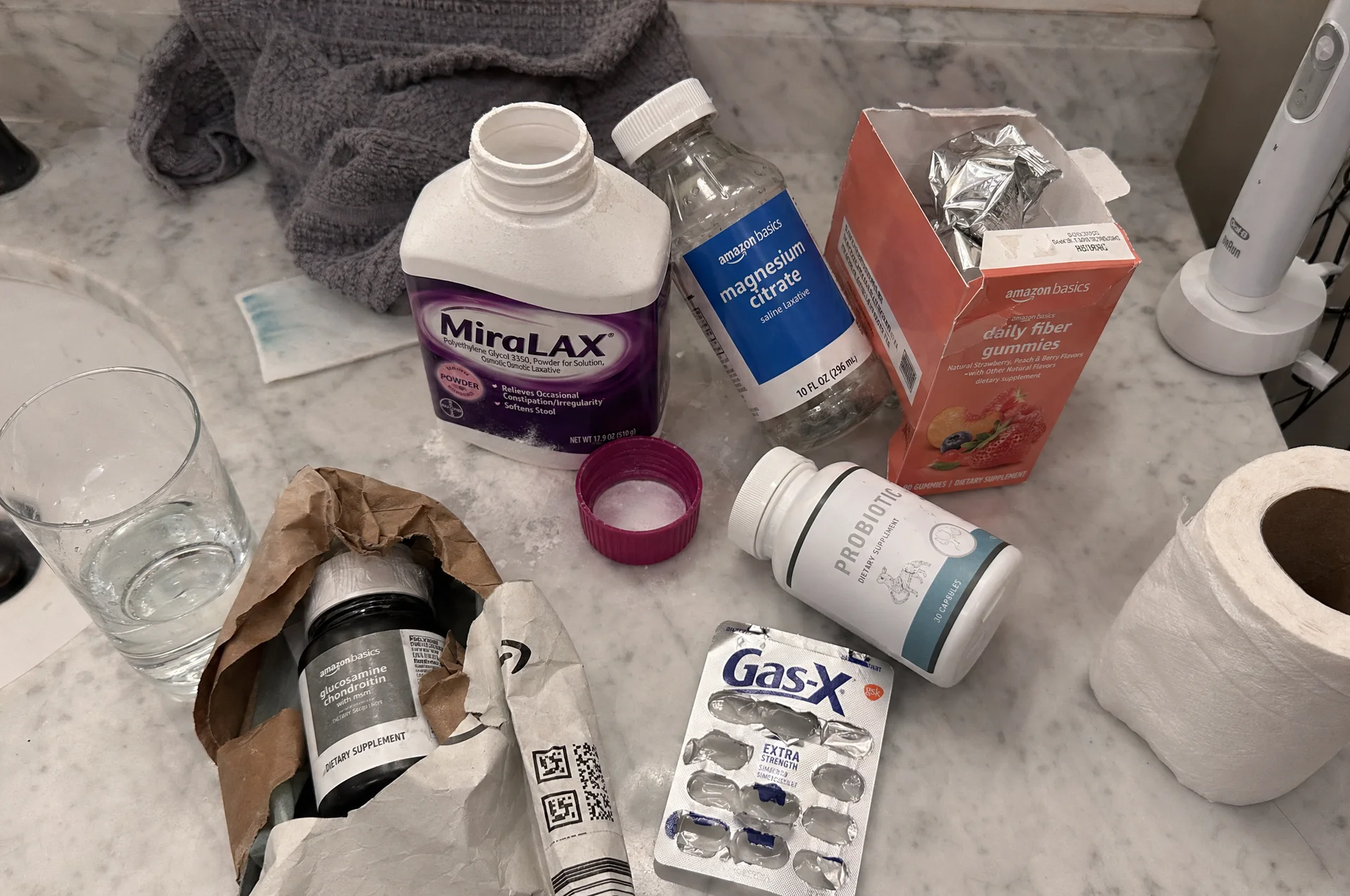
Let me walk through the pile, because I know exactly what’s in it.
Miralax. Osmotic laxative. Pulls water into the lower bowel. The food in your stomach never gets there. Doesn’t address gastric emptying.
Fiber gummies / psyllium husk. Bulks the stool, which requires food to already be moving. On a slowed stomach, fiber piles up before it ever reaches the colon and makes the bloating worse. Actively counterproductive.
Stool softeners (Colace, Dulcolax). Soften stool already in the colon. Your problem started higher up. Wrong site of action.
Magnesium citrate. Relaxes intestinal smooth muscle. Stomach has different smooth muscle, regulated by different signaling. Doesn’t address gastric motility.
Probiotics. Colonize the lower intestine. Don’t influence stomach contractions. Helpful for other conditions. Useless for this one.
The pattern is consistent. Every product is doing exactly what it was designed to do, in an organ that isn’t the source of your problem.
What I started telling my patients privately, before any of this was widely known, is that they didn’t need a stronger laxative. They needed something that addressed the stomach itself.
The Discovery That Changed Everything
Here’s the disconnect almost no prescribing doctor explains clearly.
GLP-1 medications work by slowing gastric emptying, the speed at which food leaves your stomach. That’s how they make you feel full. That’s the entire weight-loss mechanism.
In an unmedicated stomach, food typically empties in about 2 hours. In a stomach on Ozempic, Wegovy, Mounjaro, or Zepbound, food can take 6, 7, sometimes 8 hours to leave. That’s a stomach moving at a quarter of its normal speed. Sometimes less.
But the word “constipation” describes a colon problem. A colon that isn’t moving. Hard stool that won’t pass.
The food on a GLP-1 patient isn’t stuck in the colon. It’s stuck six feet upstream, in the stomach itself.
That’s why the bloating sits high and tight, just under the ribs, instead of low in the belly. That’s why the sulfur burps come from the top, not the bottom. That’s why eating anything becomes physically painful by week 3. Food can’t leave the stomach fast enough to make room for what’s coming next.

Every standard product on the shelf is designed to act on the colon. Miralax pulls water into the colon. Fiber bulks the colon. Stool softeners soften what’s already in the colon. Magnesium relaxes the colon.
None of them touch the stomach. Not one.
You weren’t crazy. You weren’t doing it wrong. You were taking products engineered to fix a different problem in a different organ.
What Actually Works on a Slowed Stomach
When I started looking for what could actually treat this, I knew any real solution would have to do three things at once.
One: restore gastric motility. It would need a compound that gently encouraged the stomach muscles to contract again, without overriding the GLP-1’s appetite-regulation effect. The research kept pointing to apigenin, a plant compound from chamomile that acts as a natural prokinetic. In a 2019 study published in the Journal of Medicinal Food, apigenin demonstrated significant improvement in gastric emptying rate in subjects with slowed motility.
Two: neutralize sulfur gas at the source. When food sits, it ferments. When it ferments, it produces hydrogen sulfide, the rotten-egg smell. Standard “gas” products break up bubbles already formed in the colon. The right solution had to bind sulfur upstream, in the stomach, before the burps reached the throat. Chlorophyllin, also known as water-soluble chlorophyll, does exactly that. It’s been used in clinical settings to neutralize body odors caused by sulfur compounds since the 1950s.
Three: support the downstream colon without bulking it. Patients still needed regular bowel movements, but psyllium-style fiber was making things worse. The answer was a soluble, low-fermentation prebiotic fiber that fed beneficial bacteria without producing more gas or adding bulk to a system already backed up.
I’m a clinician, not a formulator. So once I knew what the protocol had to look like, I started searching for an existing product that already hit all 3 pathways at clinically relevant doses.
Most didn’t come close. They’d cover one pathway. Maybe two. None at the right doses.
The one that did was a supplement called Motilli, a formulation a small specialty company had quietly built specifically for the GLP-1 patient. Three ingredients, 3 pathways, dosed at the levels the research actually supported.
Two gummies in the morning is the entire protocol. No laxative compounds, no stimulants, nothing that forces urgency, cramping, or dependency. It works with the slowed stomach instead of trying to override it. The gummy form matters more than it sounds: when you’re nauseous from the shot, one more capsule is often the thing that pushes you over the edge.

I didn’t develop it. I have no financial relationship with the company. I started recommending it to my patients the way I’d recommend any tool that does what it’s supposed to do, because nothing else on the shelf was built for the right organ.
What “Working” Looks Like
The proof in my own practice has been consistent enough that I’ve stopped writing the old protocol on my discharge sheets.
I’ll tell you my own family’s story, because I think it matters. My mother started Mounjaro 18 months ago. Lost 22 pounds. Developed every symptom in this article. I watched her cry on the phone about missing my niece’s wedding rehearsal because she couldn’t risk leaving the bathroom.
She’s been on the protocol for 9 months now. We don’t talk about her stomach anymore. We talk about what she’s planting in the garden.
What Normal Was Supposed to Look Like
Here’s what makes me angriest, looking back.
GLP-1 medications are extraordinary tools. The weight loss they enable is changing lives, lowering A1C, reversing prediabetes, saving hearts.
None of that should come at the cost of your dignity at every restaurant table.
Patients who get the gastric piece right keep the weight loss, keep their medication, and stop paying what I’ve started calling the “gut tax.” The $80 to $100 a month, the social isolation, the constant low-grade misery that everyone treats as the inevitable price of being thinner.
It isn’t inevitable. It’s a treatable mechanism that the standard protocol doesn’t address.
What Patients Are Saying
Availability
Because GLP-1 prescriptions have grown faster than anyone forecasted, demand for Motilli has outpaced production three quarters in a row. Inventory is allocated in batches. As of this writing, the company is offering up to 40% off for first-time customers, plus the option to lock in subscription pricing before the next batch closes.
Every order is backed by a 90-day money-back guarantee. Use the full bottle. Use the second bottle. If your stomach doesn’t reset, you get every dollar back without returning the bottles or answering any questions.
Your prescribing doctor should have given you a plan for your stomach when they wrote the prescription. Most didn’t. This is the plan I now recommend to every GLP-1 patient who walks into my office.

Frequently Asked Questions
This is an advertisement and not an actual news article, blog, or consumer protection update. The story depicted on this site and the persons depicted in the story are not actual news. Results may vary and are not guaranteed. These statements have not been evaluated by the Food and Drug Administration. This product is not intended to diagnose, treat, cure, or prevent any disease. Consult your healthcare provider before starting any supplement, especially if you are taking prescription medication including GLP-1 receptor agonists.
This is a paid advertisement. © 2026 Motilli. All rights reserved. getmotilli.com